
How to Choose the Right Exercises for Your Type and Stage of Frozen Shoulder
f you are searching for frozen shoulder workouts, you are likely already dealing with stiffness, pain, and frustration. You may have tried stretching, mobility exercises, or workouts found online, only to feel unsure whether they are helping or making things worse.
The truth is, frozen shoulder workouts are not one-size-fits-all. What helps one person can feel ineffective or aggravating for another. The difference often lies not in the exercise itself, but in the type of frozen shoulder and the stage it is in.
We previously published this article, which helps you choose workouts more wisely so that movement supports recovery rather than working against it.
What Frozen Shoulder Workouts Are Meant to Do

Before you start
Frozen shoulder workouts are often misunderstood. Their role is not to force the shoulder back into full range of motion or to “break through” stiffness.
At different points in recovery, workouts are meant to:
- Maintain the existing range of movement
- Reduce guarding and fear of movement
- Support circulation around the shoulder
- Prepare the shoulder for gradual recovery
Pain is not a sign of progress. In frozen shoulder, timing and appropriateness matter more than intensity.
Workouts for Primary Frozen Shoulder
Primary frozen shoulder develops gradually without a clear injury and often progresses through the classic freezing, frozen, and thawing stages.
When Workouts Are Helpful
Workouts are generally most helpful:
- In the early freezing stage, when pain is present but movement is not fully restricted
- In the thawing stage, when pain reduces, and movement begins to return
What Types of Workouts Are Suitable
At appropriate stages, suitable workouts focus on gentle, pain‑free movement that supports circulation and reduces guarding. Below are safe, commonly recommended options with simple step‑by‑step guidance. Stop if sharp pain occurs and keep all movements within your comfort zone.
1) Assisted Range‑of‑Motion (Using the Unaffected Arm)
Purpose: Maintain mobility without forcing the shoulder
How to do it:
- Sit or stand upright, with your shoulders relaxed.
- Use your unaffected arm to support the wrist or forearm of the affected side.
- Gently guide the affected arm into a comfortable range (forward lift and across the body).
- Move slowly, stopping before pain increases.
- Return to the starting position with support.
Guidelines:
- 5–10 slow repetitions per direction
- 2 sets, twice daily
- Movement should feel assisted, not forced
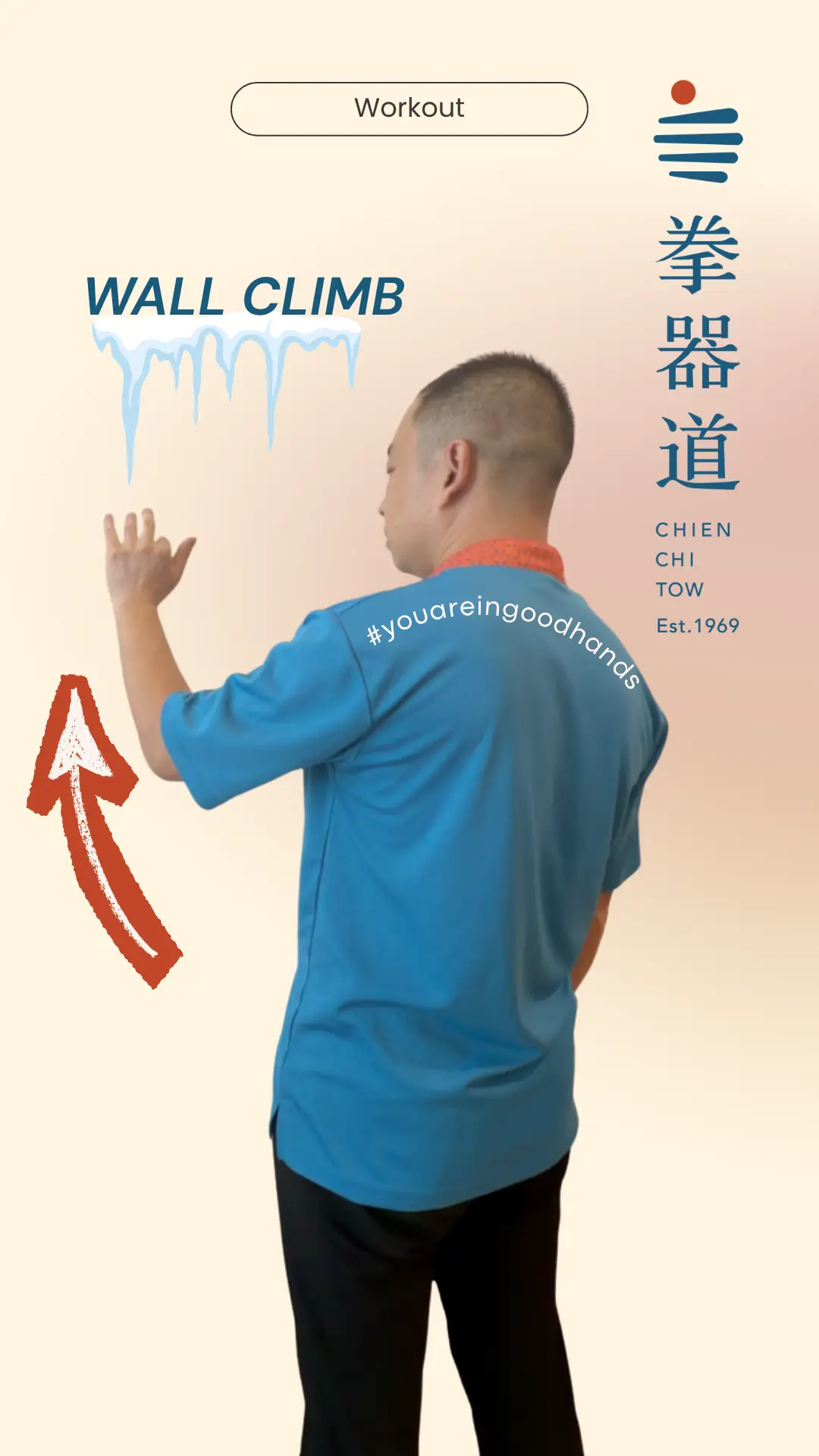
2) Wall Climb (Supported Lift)
Purpose: Maintain mobility without forcing the shoulder
How to do it:
- Front facing the wall with the palm of your affected arm pressing the wall.
- Slowly move your arm upwards with your fingers assisting the climb.
- Move slowly until you feel the tension.
- Return to a comfortable position before attempting again.
Guidelines:
- 5 – 10 slow repetition
- 2 sets, twice daily
- Movement should feel controlled, stable and supported.
Key reminders:
- Discomfort that eases quickly is acceptable; sharp or increasing pain is not.
- Consistency matters more than intensity.
- If movement feels increasingly restricted or painful over time, reassess rather than push harder.
These movements aim to maintain mobility without irritating the joint and are best adjusted according to your type and stage of frozen shoulder.
What to Avoid
- Forcing stretches beyond comfort
- Aggressive range-of-motion exercises
- Heavy strength training too early
Trying to push through pain usually makes the shoulder tense up further and can slow the healing process.
Workouts for Secondary Frozen Shoulder
Secondary frozen shoulder develops after another event, such as injury, surgery, or prolonged immobilisation. Because there is an underlying cause, recovery often requires more patience.
When Workouts Are Helpful
Workouts tend to be more effective:
- After acute pain or inflammation has settled
- When movement is reintroduced gradually and deliberately
What Workouts Should Focus On
For secondary frozen shoulder, workouts should prioritise safe reintroduction of movement while respecting the shoulder’s reduced tolerance after injury, surgery, or prolonged immobilisation. Below are commonly used, low-risk movements with step-by-step guidance. Keep all movements slow and within your comfort zone. Stop if sharp pain, pinching, or worsening night pain occurs.
3) The "Butterfly" Shoulder Stretch
Purpose: Gradually reintroduce forward shoulder movement without overloading the joint
How to do it (step-by-step):
- Sit or stand up straight. Lace your fingers together and place your hands behind the back of your head.
- Lift your chest and hold your head high. You should start to feel a slight pull in your shoulders and chest.
- Slowly pull your elbows back as far as they will go. Hold it for a moment to feel the stretch.
- Gently swing your elbows forward (like you’re closing a book) and then back again (opening up). Keep this rhythmic motion going to loosen up your joints.
- When you’re done, lean slightly forward and slowly let go of your hands.
Guidelines:
- 10 repetitions per set
- 1–2 sets, twice daily
- Movement should gradually feel more comfortable and shoulder will become more flexible.
4) Shoulder and Tricep (Flossing)
Purpose: Encourage shoulder motion and stress the shoulder lateral muscle
Equipment: long towel or a yoga strap
How to do it (step-by-step):
- Hold one end of a towel with your unaffected arm and lift it over your head. Let the towel hang down behind your back.
- Reach behind your lower back with your affected arm and firmly grasp the bottom end of the towel.
- Slowly pull the towel upward with your top hand. This creates internal rotation to stretch your shoulder’s lateral muscles.
- Reverse the movement by pulling the towel downward with your bottom hand. This creates external rotation to stretch the triceps of your upper arm.
- Continue this “flossing” motion (pulling up and down) for 10 to 15 repetitions.
Guidelines:
- 10 – 15 repetitions
- 2 sets daily
- Keep the movement smooth and controlled
Key reminders:
- Focus on control and comfort rather than range.
- Gradual progress is expected; avoid rushing improvement.
- If stiffness or pain worsens over time, reassessment is more helpful than pushing harder.
What to Avoid
- Treating the shoulder as if it were simple stiffness
- Rushing progression
For secondary frozen shoulder, exercises tend to work better when they are carefully tailored to your condition, rather than performed aggressively or copied directly from generic routines.
Workouts for Pseudo Frozen Shoulder
Pseudo-frozen shoulder refers to stiffness or pain that mimics frozen shoulder but is caused by muscle tightness, postural strain, or referred pain from the neck or upper back.
Why Workouts Often Help More Here
Because the shoulder joint itself is not truly frozen, workouts often lead to faster, more noticeable improvement.
What Types of Workouts Are Most Helpful
Because pseudo-frozen shoulder is usually driven by posture, muscle tension, and movement habits rather than by true joint capsule restriction, workouts often feel more effective here. The goal is to restore normal movement patterns and reduce unnecessary strain.
Below are simple, practical workouts with step-by-step instructions that commonly help.
5) Upper-Back Extension (Posture Reset)
Purpose: Improve upper-back mobility and reduce shoulder strain caused by slouching
How to do it (step-by-step):
- Sit upright on a chair with both feet flat on the floor.
- Place your hands behind your head or cross your arms over your chest.
- Gently arch your upper back backwards while keeping your lower back stable.
- Look slightly upward as you open your chest.
- Hold for 3–5 seconds, then return to neutral.
Guidelines:
- 8–10 repetitions
- 1–2 sets daily
6) Neck Side Glide and Rotation (Neck–Shoulder Release)
Purpose: Reduce referred pain from the neck to the shoulder
How to do it (step-by-step):
- Sit or stand upright with shoulders relaxed.
- Gently tilt your head toward one side (ear toward shoulder).
- Return to the centre, then rotate your head slowly to look over your shoulder.
- Move only within a comfortable range.
- Repeat on the other side.
Guidelines:
- 5–8 repetitions each direction
- Once or twice daily
Key reminder: If these movements improve comfort and range relatively quickly, it often suggests the issue is not true frozen shoulder, but rather a movement or posture-related condition that responds well to targeted exercises.
Stage-Based Workout Guidance (Regardless of Type)
Understanding the stage of frozen shoulder helps determine the appropriate workout intensity.
Freezing Stage (Pain-Dominant)
- Goal: Reduce irritation and maintain comfort
- Intensity: Very low
- Focus: Gentle, pain-free movement
Avoid pushing range or intensity at this stage.
Frozen Stage (Stiffness-Dominant)
- Goal: Prevent further stiffness
- Intensity: Low to moderate
- Focus: Assisted and controlled movement
Consistency matters more than intensity.
Thawing Stage (Recovery Stage)
- Goal: Restore function gradually
- Intensity: Moderate and progressive
- Focus: Active mobility and light strengthening
Progress should be steady, not rushed.
When Workouts Are Not Enough
Workouts alone may not be sufficient if:
- Night pain persists
- Shoulder movement continues to decline
- Pain spreads to the neck or upper back
- There is little improvement despite consistent effort
This does not mean you are doing something wrong. It often means the shoulder needs additional support.
How TCM Treatment Supports Frozen Shoulder Recovery
From a TCM perspective, frozen shoulder is associated with restriction, reduced circulation, and compensatory patterns involving surrounding areas.
TCM treatment, including Tuina, can help by:
- Reducing muscular guarding
- Improving circulation to restricted areas
- Supporting gradual improvement in mobility
When used appropriately, TCM treatment complements movement rather than replacing it, helping the shoulder respond better to workouts.
Why Professional Assessment Changes Outcomes
Professional assessment helps to:
- Identify the type and stage of frozen shoulder
- Match workouts to the shoulder’s current condition
- Avoid unnecessary aggravation or prolonged recovery
This clarity allows movement and treatment to work together more effectively.
Choosing Smarter, Not Harder
Frozen shoulder workouts can support recovery when chosen thoughtfully. The key is not to do more, but to do what is appropriate for your shoulder at this time.
Understanding your type and stage helps you move forward with confidence rather than frustration.
Book Now
Special Trial Price
TCM Targeted Treatment
You are in good hands recovery is guided by understanding, not guesswork.
This article is part of Chien Chi Tow’s lifestyle pain education series, created to help working adults and active individuals make informed decisions about shoulder care.